It is also said that, it is on this Kanuma that Lord Krishna lifted the Govardhana mountain to save people, cattle and many lives.
Food items with Sesame seeds (nuvvulu - aresalu) and Urad dal(minapappu - Garelu) are made on this day.
Aresalu


Garelu


Makara Sankranthi day starts with decorating the houses, putting rangolis, having early morning oil head baths and wearing new clothes. Sun god is worshiped on this day. Milk is boiled and offered to Sun god. There is an astronomical significance of this day: this is the first day of Uttarayana, Sun moves northward for a period of six months. The rest of the six months, Sun is in Dakshinaayana – the south. This period is considered auspicious. Otherwise said - Makara Sankranthi is the event of the Sun entering the zodiac sign of Makara or Capricorn. Various food items are made and there is enjoyment all around in the family.
 Bhogi is the first day of the Sankranti festival. Early morning people light bonfire (bhogi mantalu) made out of cow-dung cakes (traditionally), old wooden articles to get the warmth in the winter. People dance around the bonfire, singing songs in praise of the gods, the spring and the harvest.
 In the evening, a function is arranged for the children and it is called Bhogi palla perantam. A bowl of small Bear fruits (regi pallu), Flower petals, coins of money and yellow rice grains (akshintalu) is prepared and will be moved around the little one’s heads for about three times and will be poured on their heads. The reason is to remove all kinds of bad or evil on the kids.
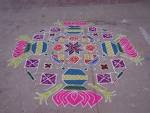 (colour) and aavalli ('coloured creepers' or 'row of colours'). It is a form of sandpainting decoration in front of the houses that uses finely ground white powder and colours. Women get up very early in the morning and start drawing colorful rangolis. They also decorate the rangoli with flower petals.
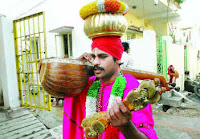 The first visitor in festival time he is never denied of alms as it is auspicious to give the new crop in charity for better prosperity. The Haridasulu carry a copper vessel, made in the form of a pumpkin, on their head. They carry cymbals in one hand and a tambura in the other and go from house to house singing, 'Harilo Ranga Hari', and the glory of Lord Vishnu. This tradition is very much seen in the villages and towns and is very rare in our city life.


 Today - 8th october 2008, the eighth day of Dasara, also known as Maharnavami - Goddess is decorated as Sree Rajarajeshwari devi.
 Today - 6th october 2008, the seventh day of Dasara, Goddess is decorated as Sree Saraswathi devi.
 5th october 2008, the sixth day of Dasara, Goddess is decorated as Sree Maha Lakshmi devi.
 Today - 4th october 2008, the fifth day of Dasara, Goddess is decorated as Sree Lalitha Tripura Sundari devi.
 Today, 3rd October 2008 - the fourth day of Dasara, Goddess is decorated as Sree Annapurna devi.
 Today, 2nd October 2008 - the third day of Dasara, Goddess is decorated as Sree Vedamata Panchamukhi Gayathri devi.
 Today - 1st october 2008, the second day of Dasara, Goddess is decorated as Sree Bala Tripura Sundari devi.
Dasara, also known as Navaratri is the time of worshiping the Goddess. Goddess is very powerful. Each day (in the 9 days), the goddess is decorated in various avatars and is worshiped. One of the ways to celebrate this festival (as I do) is to perform the respective goddess Ashtotram (recite the 108 names of the goddess) and then read Sree Lalitha Sahasranamam and then offer the prasadam that is for that day.
The following are the avatars of the godess.
Durga
Bala Tripura Sundari
Gayathri
Annapurna
Lalitha
Lakshmi
Saraswathi
Raja rajeshwari
Mahishasura mardhini


